Our Story
The Banya
A thousand-year-old ritual of heat, steam, and cold — brought to the Goan coast, at home among the palms.
Chapter I · The Roots
An old word for an older practice
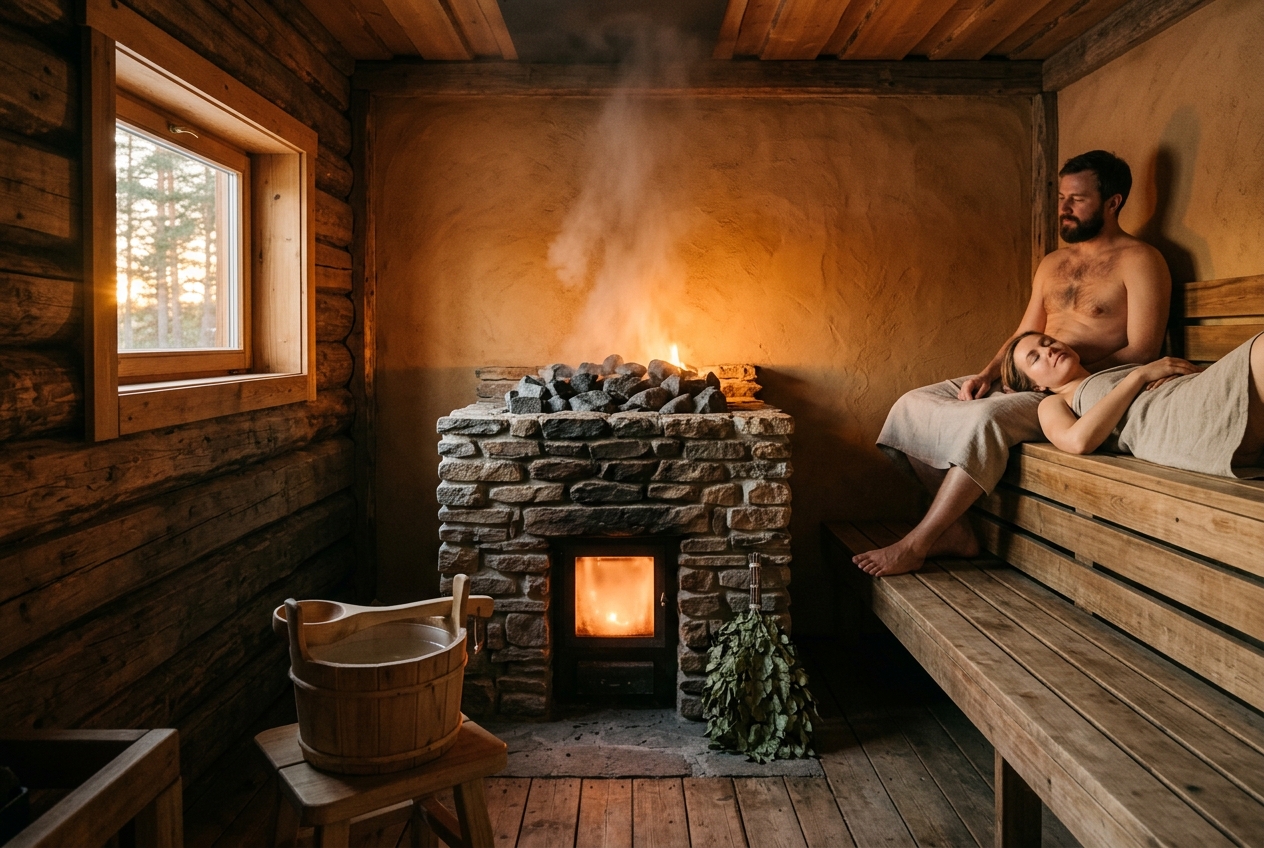
A banya is, at its simplest, a bathhouse — a warm room of wood and stone where water is poured on heated rocks to make steam. But to call it a sauna, in the Nordic sense, undersells it. The banya is slower, wetter, and more communal. It has its own vocabulary, its own etiquette, and its own spirit. For most of Russian history it was less a luxury than a piece of the household — as essential, and as unremarkable, as the hearth.
Even the word travels a long way. Banya (баня) descends, through Old Church Slavonic and Proto-Slavic, from the Latin balneum — itself a borrowing from the Greek balaneîon. It is a cousin of the Italian bagno and the French bain. But if the word came from the south, the practice did not. Sweating over hot stones is far older than any name for it, rooted in the forest cultures of the Slavic and Finno-Ugric north.
The earliest written record
The oldest surviving description of the banya sits in a twelfth-century manuscript — the Primary Chronicle, compiled around 1113 in Kievan Rus'. The chronicler records a traveller's account of the land that would become Novgorod, and pauses, evidently delighted, to describe what he found there: wooden bathhouses heated to a fierce heat, the bathers anointing themselves, beating themselves with bundles of branches, then dousing themselves in cold water — emerging, he wrote, barely alive, only to do it all again the next day.
The passage is almost certainly a legend, not a record. The Primary Chronicle was written to tell a story as much as to keep one, and it attributes the sighting to Andrew the Apostle — who, even in tradition, travelled these lands centuries earlier. Historians read it as the chronicle's way of saying: this practice is old, and it is ours.What it tells us reliably is that by the 1100s the banya was already so woven into Slavic life that it needed no introduction.
The cleanest place in the village
In a Russian village without plumbing, the banya was often the most hygienic structure for miles — the one place a person could get properly clean. It was communal by necessity, shared by turns. But cleanliness was only the start of it. The banya was the village's unofficial clinic, its birthing room, and its place of purification. Folk healers — theznakhari — worked there, treating colds and aching joints with herbal steam and massage. Women gave birth inside the banya, attended by midwives, because it was warm, private, and had water on hand. After illness, after childbirth, after a death in the family, the first stop was the banya: to be washed, to be reset, to begin again.
A peasant proverb, now the title of a scholarly history of the bathhouse, puts the whole relationship in five words: without the banya we would perish.
The spirit in the corner
Because the banya stood at the edge of village life — literally, often built apart from the house, and figuratively, the place where the body was opened and made vulnerable — folklore gave it a guardian. Every banya had its bannik, a capricious spirit who lived behind the stove. He was not exactly worshipped and not exactly welcome. He was accommodated. You left him a little soap, a little water. You did not bathe alone, or after dark, or in his turn — the last shift of the day was always his. Cross him, the stories warned, and he might scald you, or steam you senseless, or burn the place down. Keep on his good side, and he would keep the bathhouse sound.
No one at Hidden Oak still believes in the bannik. But the instinct behind him — that the bathhouse is a place to enter with respect, and a little humility — is one we have kept.
Chapter II · The Ritual
Heat, cold, rest — and repeat
The banya is not a thing you do once. It is a cycle, and the cycle is the point. You warm slowly in the steam, you cool sharply in cold water, and you rest. Then you do it again. Two hours, three hours — the pace is set by the body, not the clock.
Light steam
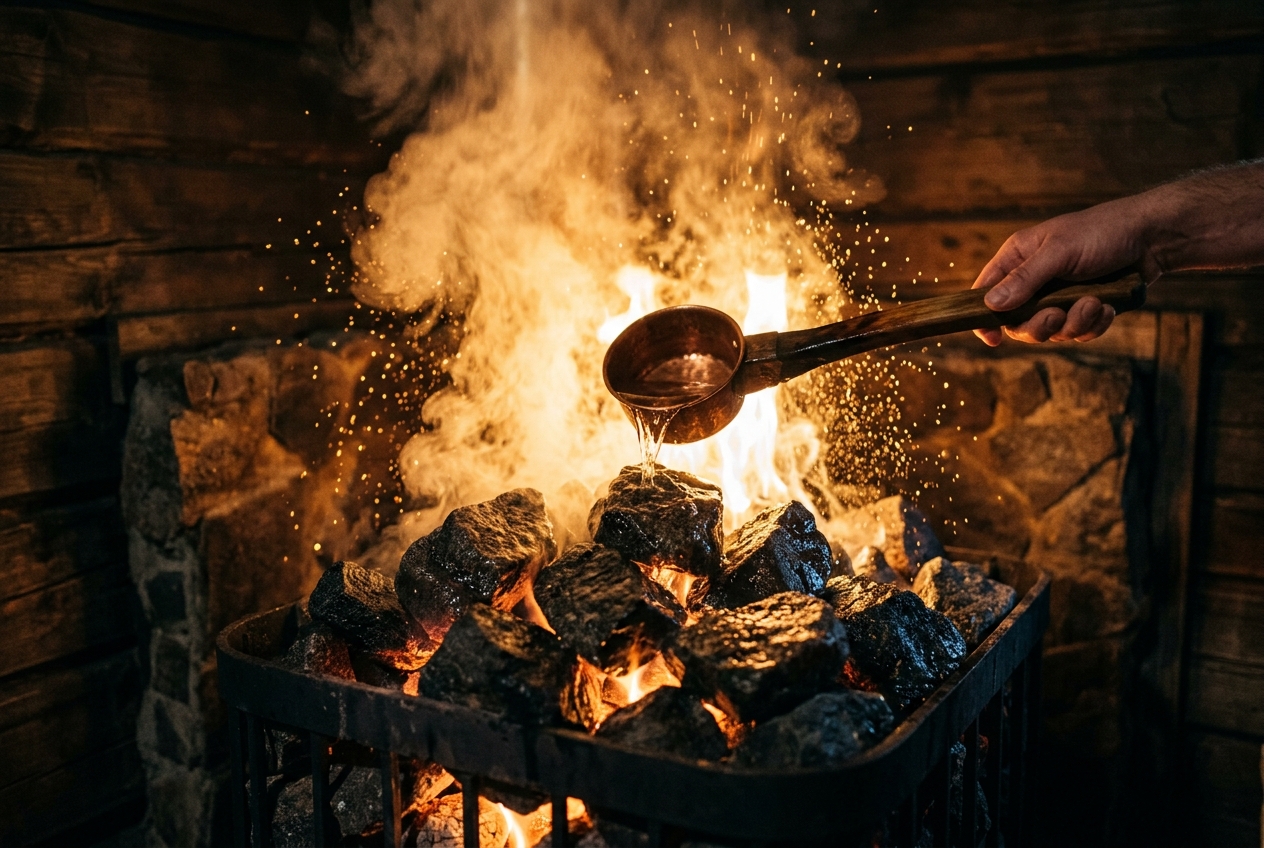
The steam room — the parilka — is built around a stove of stone, the kamenka. When the stones are good and hot, you ladle a little water onto them through the vent. The trick is restraint: a small amount of water on very hot stone becomes a fine, light vapour that the Russians call lyogkiy par — "light steam." Too much water and the air goes heavy and clammy, which is the opposite of what you want. When someone finally steps out, done, the traditional greeting from those outside isS lyogkim parom — "may your steam have been light."
The venik
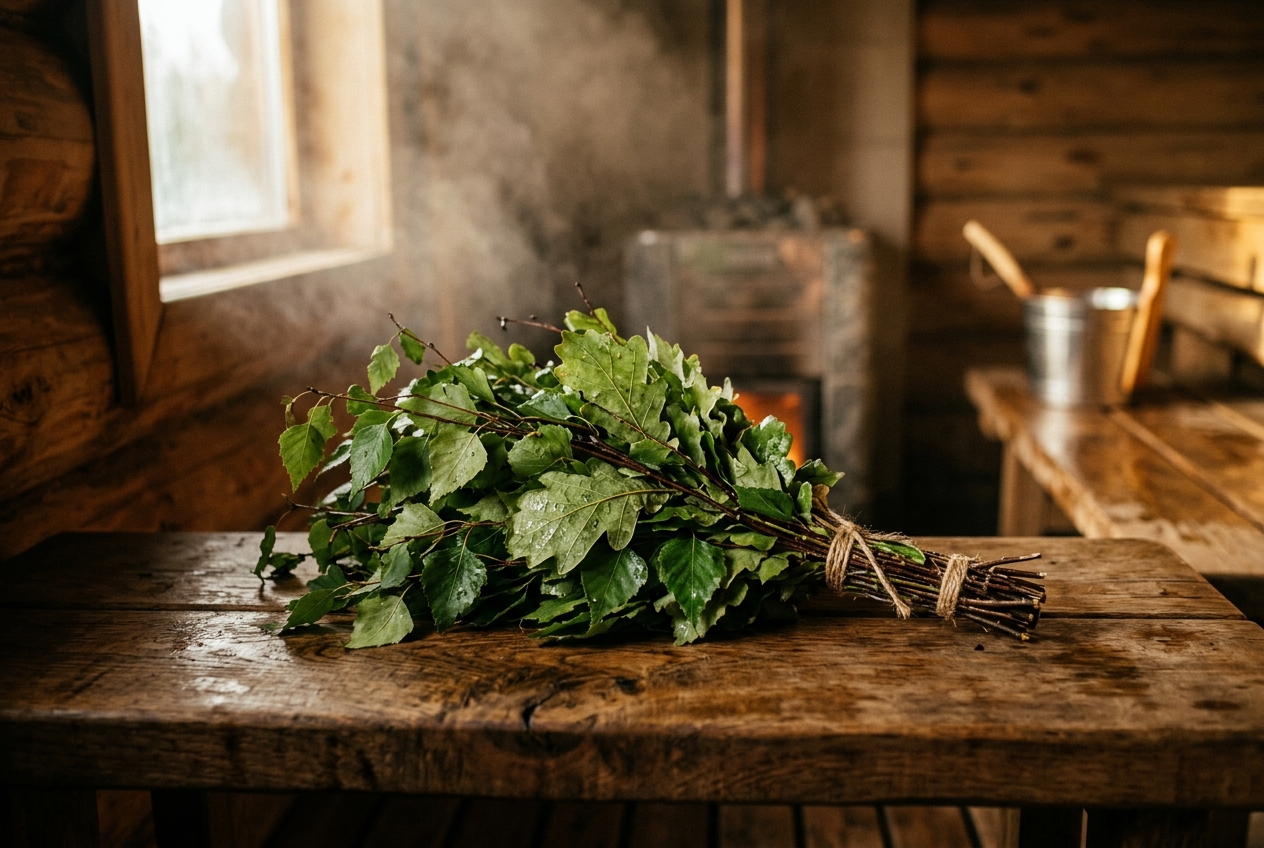
Then there is the venik: a bundle of leafy branches, soaked in warm water until supple, used to fan the hot steam across the skin and to work the muscles with a gentle, rhythmic tapping. Done well, it is closer to a massage than a beating — the leaves carry the heat, release their own oils, and leave the skin flushed and lightly exfoliated.
Two woods do most of the work. Birch is the classic — its leaves are soft, full of essential oils, and traditionally believed to ease aches and open the chest. Oak is firmer, the leaves broader and richer in tannin, used for a deeper, more astringent pass that is said to be good for the skin. (Hidden Oak, we should admit, is named for the second.) Eucalyptus turns up in modern banyas too — not traditional, but welcome for the way it clears the head.
The cold
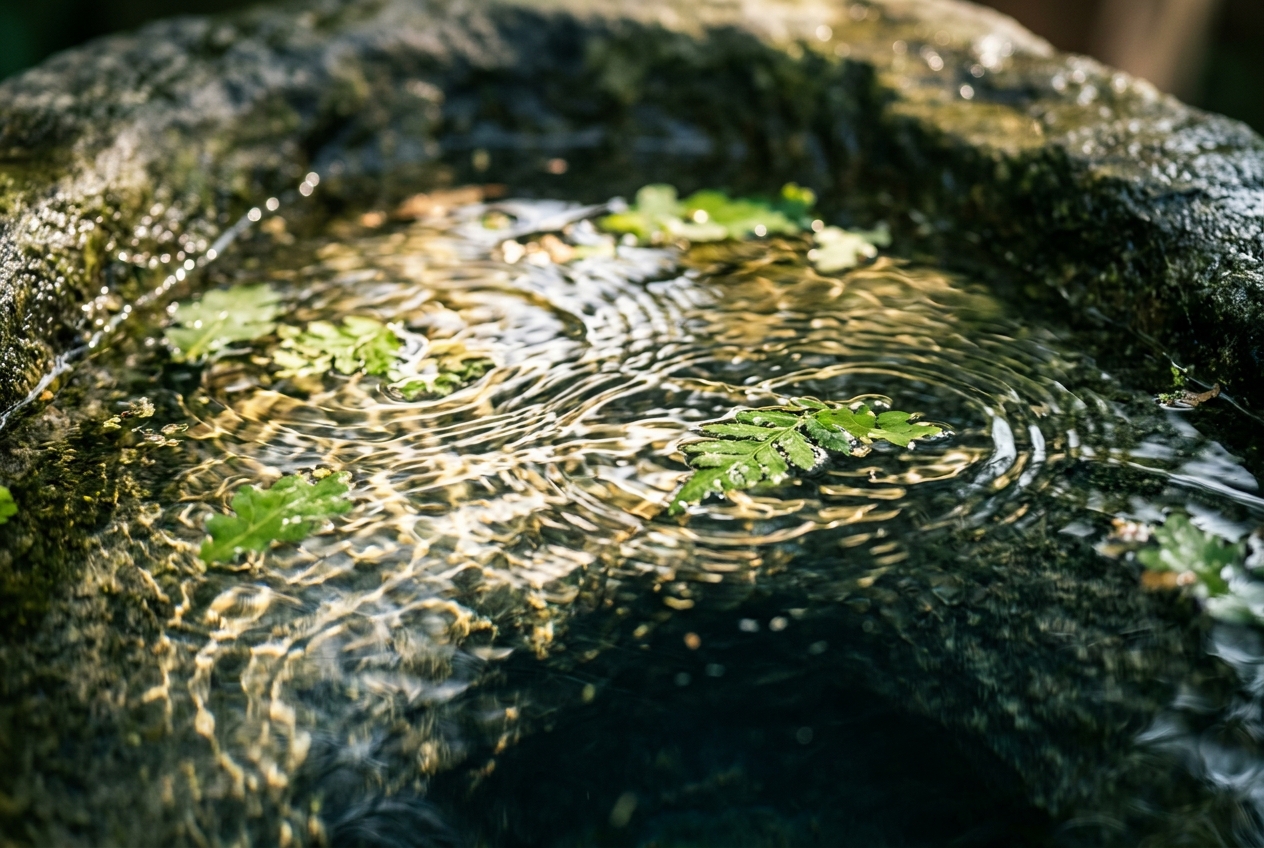
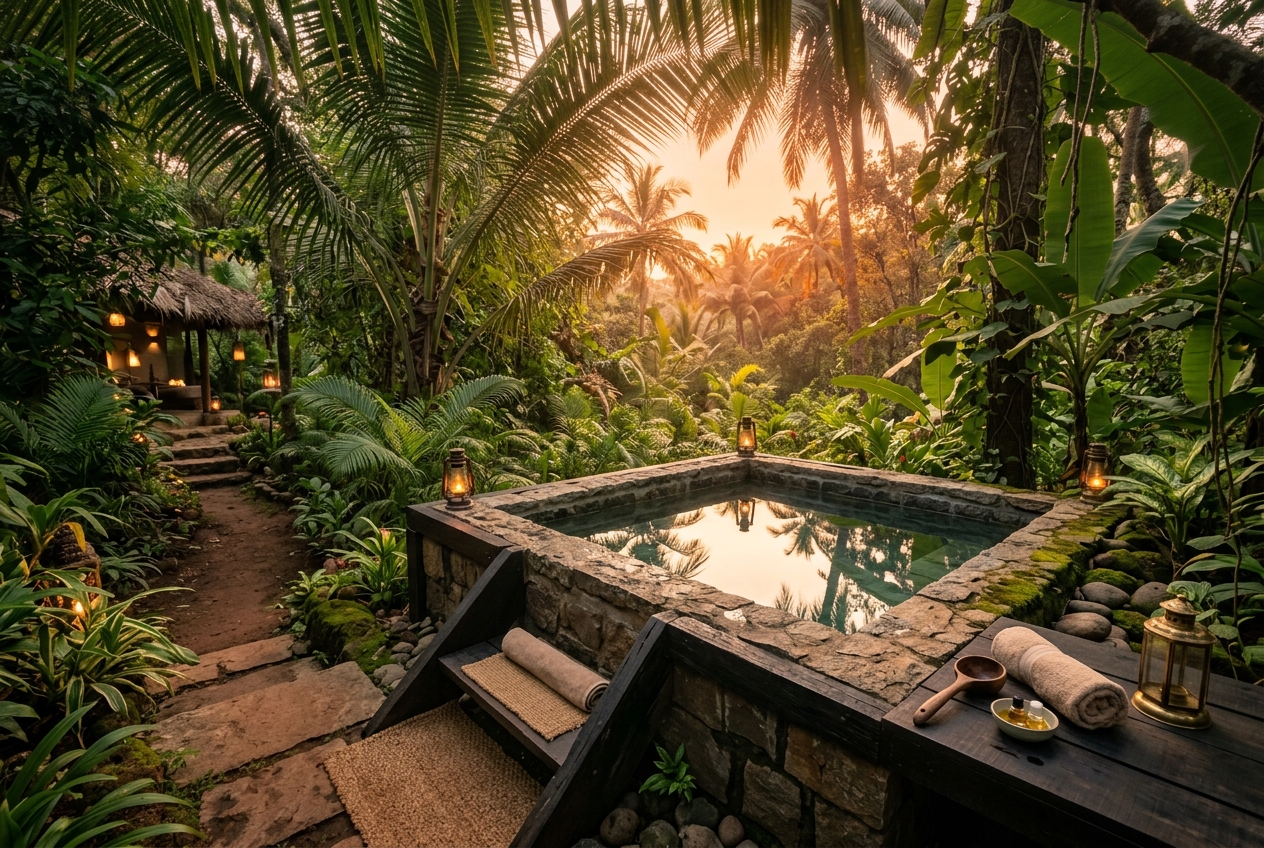
And then — out. Into the cold. In a Russian winter this means a snowbank, or a hole cut through the ice of a frozen river. The shock is total, and brief, and the body comes back out of it singing. In the banyas of today, the cold is more often a wooden plunge tub — a kupel — kept cold enough to do the same job. Heat opens; cold closes. One without the other is only half the practice.
Tea, and the space between
Between rounds, you rest. A traditional banya has a room just for this — the predbannik, the "before-the-banya," where the benches and the clothes pegs live. Here you sit, cool down, drink tea — strong black tea, or herbal, often with honey or jam — and let the body settle before the next round. This is where the social life of the banya happens: the long, unhurried conversations that are, for many, the real reason they came.
Chapter III · The Fusion
From the birch forest to the Goan coast
Hidden Oak did not set out to build a museum. The question was neverhow do we reproduce a Russian banya in Goa — the climate is wrong, the materials are wrong, and a faithful replica would feel exactly like one. The question was: what from this tradition is worth keeping, and what can it become here?
Earth walls, warm wood
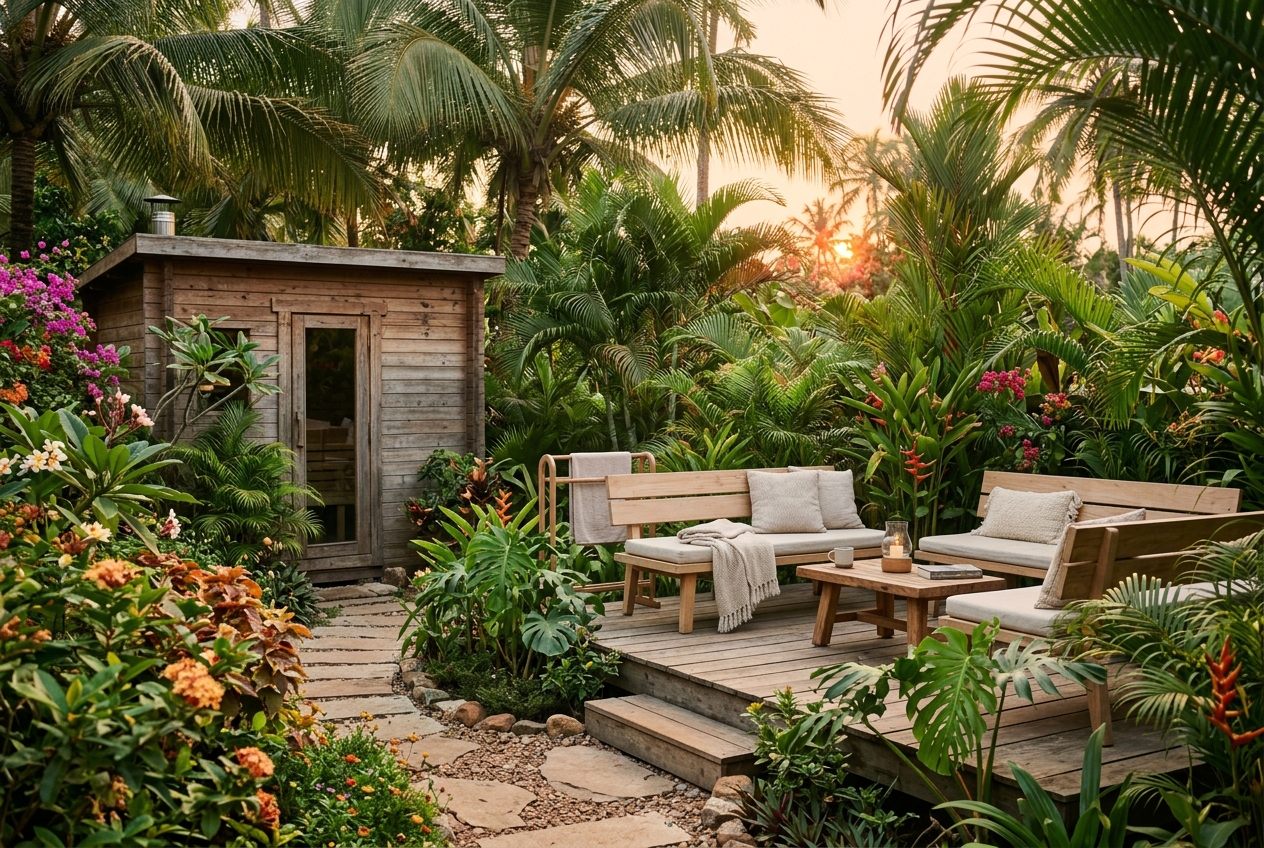
A traditional banya is built from what is around it — timber, stone, clay. In Goa, what is around is laterite earth, palm timber, and a long local tradition of building with mud. So the walls at Hidden Oak are plastered earth, not planed pine — the same troweled clay finish you see on village houses across the Konkan coast. The mass of those walls holds heat the way a stone kamenka does: slowly, evenly, deep into the evening. The wood is local and tropical, chosen to take the humidity. Nothing is imported to look the part.
Among the palms
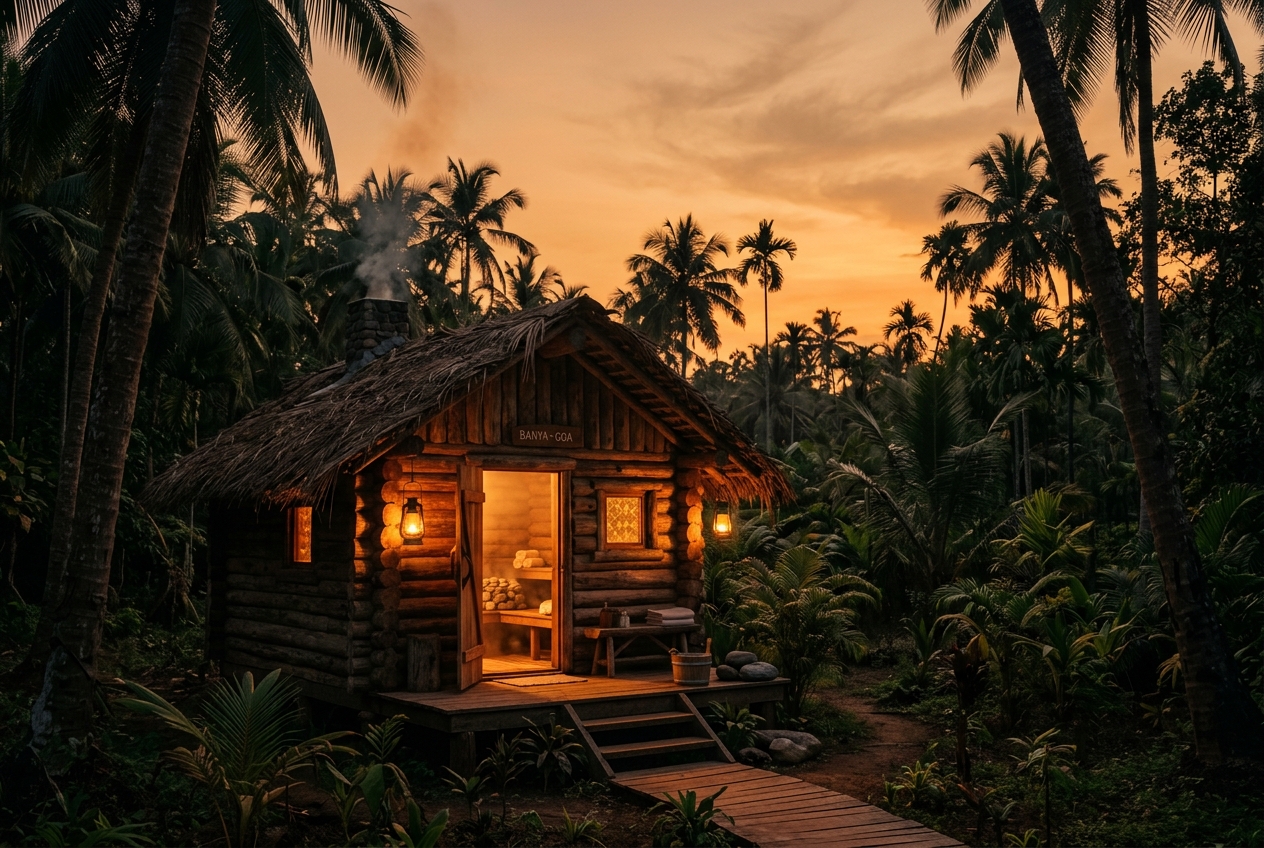
And then there is the setting. A Russian banya belongs in a birch forest in winter: the snow outside, the steam inside, the contrast doing its work. We do not have the snow. We have, instead, the quiet end of an Arambol lane — palms and cashew trees, the sea close enough to hear on a still day, the air heavy and warm. The cold plunge is not a hole in the ice; it is a tub kept cold against the tropical heat, and the shock of it is no less real for the green outside the door. The contrast here is not hot-and-frozen. It is hot-and-cool, under a canopy, in the tropics. It is its own thing.
An older neighbour
What surprised us, building it, was how close the banya sits to traditions that were already here. India has its own thousand-year practice of medicinal steam. In Ayurveda it is called swedana — from the Sanskrit for sweat — a sudation therapy used to open the body's channels, ease stiffness, and prepare for purification. Herbal steam, the movement of heat through the body, the careful rhythm of warmth and rest: these are not Russian ideas, or Indian ideas. They are human ones, arrived at independently, in more than one forest.
So Hidden Oak does not pretend to be Ayurvedic, and it does not pretend to be purely Russian. It is a Russian banya built in the Indian way, with local earth and local wood, in a place that has drawn people looking for quiet and recovery for longer than most. Arambol has been a stop on the trail for seekers and travellers since the late 1960s — not ancient, but not new either. We are, in a sense, the latest guests in a village that has been hosting for half a century.
What stayed, what changed
What we kept: the cycle of heat and cold, the venik, the slow pace, the tea between rounds, and the feeling — hard to name but unmistakable — of leaving cleaner and lighter than you came.
What we changed: the snowbank, obviously. The birch, mostly — we use what the climate allows, and let eucalyptus and local aromatic leaves stand in where a Russian forest would have provided. And the walls, which are the colour of the earth they came from.
The result is not a Russian banya with a Goan postcode. It is something that could only exist here — earthy, warm, and a little wild. We call it Hidden Oak, and we would like to show you what we mean.
Come and feel it
The best way to understand it is to step inside.
Sessions run by appointment, seven days a week. First-timers always welcome.